How to make more impact in your coaching sessions in 3 minutes
You know it. Your client seems to have yet to land within the first half hour of your meeting. Or he (or she of course…) still has a whole story to tell before you can get to the point. Your customer is stressed or perhaps curt, disappointed or apathetic. It can all happen. While you were prepared to have a blast during this session, you first have to work hard for half an hour to get back to a workable situation.
The desire to work more effectively
Let me first say that in coaching you work with what is there and, especially as far as I'm concerned, if that serves the purpose. So if your customer is stressed, you do something with that stress, like examining it or talking about it or whatever it is that you do. However, that doesn't change the fact that you sometimes have the thought: "Can't this be done a little faster or more effectively"? can have. The same applies to the results of the sessions, can you ensure that more sticks, you can work faster and deeper with someone and you don't have to fit a lot of time into your session? I think so.
In this blog I will take you through a simple way to create more impact with your customer, by working with the right breathing. And of course I will tell you why this is so effective for you and your customer.
Breathing has recently become very popular as a method or tool for coaching and that is not surprising, because breathing is extremely effective. For example, if you have ever done Wim Hof's breathing, you know how much impact a short breathing exercise can have.
This is because breathing is inextricably linked to the state of our autonomic nervous system. And the state of our autonomic nervous system directly determines how we learn, respond and perceive. Influence on the state of our nervous system therefore influences our perception, reaction and our learning efficiency!
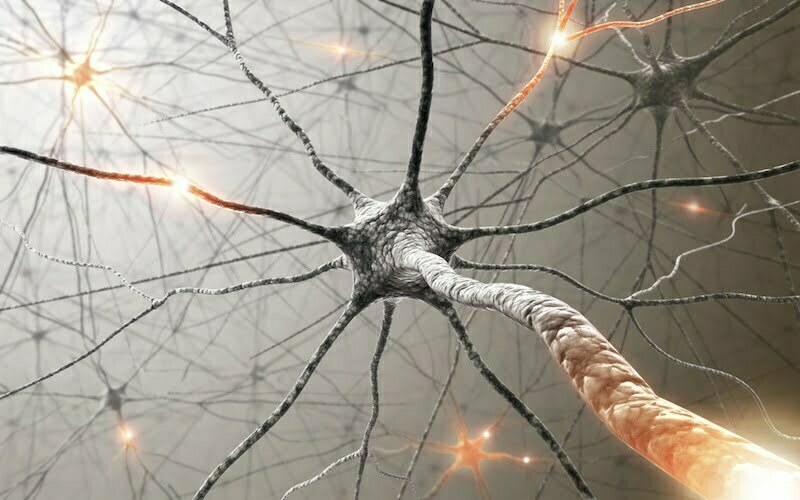
Our autonomic nervous system explained
In short: networks run throughout your body that connect your organs, muscles and brain with each other and allow them to communicate. These networks, also known as nerves, ensure communication by passing signals between the cells that make them up: nerve cells, also called neurons. We therefore also speak of networks of neurons or 'neural networks'.
For example, your eye uses neurons to process light and transmit that information to your brain. Your muscles receive signals via your neurons to contract or relax. Feeling pain when you stub your toe is because you have neurons in your toe that register that your foot comes to a stop too hard against the curb. All information that is processed and transmitted in our body goes through interconnected neurons.
We appropriately call this complete package of neural networks that transmit and process signals: your nervous system.
Now it is true that a large part of your nervous system functions completely outside of you. Which is perhaps a good thing. That part that operates completely independently is called the autonomic nervous system and it regulates, for example, your heart rate, breathing and digestion.
This connection is important to remember. Your autonomic nervous system is therefore connected to your heart, your breathing, your abdominal organs, but also to your brain.
2 systems
Sympathetic and parasympathetic nervous systems
The first ensures that you can take and continue to take action, for example if you suddenly see a child crossing the road on your bicycle, or if you have to perform a sports performance. It is also called the fight or flight system, because it puts your body in action mode. Heart rate, breathing, muscle tension will all increase and you will suddenly feel more alert, for example. This sympathetic system is also active during stress.
The other system ensures that you feel relaxed, that you get a normal heart rate again after the near-cycling accident and that your muscles recover after exercise. It is your rest and recovery system. Your heart rate and muscle tension are lower and your digestion gets going. You generally feel relaxed or may even be sleeping well.
What is the implication of this for coaching?
Generalizing, you can say that stress and our sympathetic system narrows our focus and reduces our creative learning capacity. After all, it is aimed at survival, not at learning and living.
Although it may be tempting to think that you want people to use that parasympathetic system as much as possible, the question is whether that is correct.
After all, you want your customer to benefit as much as possible from a session and for as much to stick around as possible. This does not work optimally even in complete relaxation. Just ask yourself whether you are in the optimal learning mood in the sauna.
The trick is to find a middle ground, a state of balance for the customer. Now this is of course what many coaches also realize. You have to relieve the customer of stress or get him moving. So we will discuss how we can reduce stress or increase motivation. We ask questions or provide information or assignments.
But now take into account that the state of the autonomic nervous system determines how we process information. So when someone is stressed or apathetic, they process information differently than when they are in their normal state (balance).
Couple…
... your customer received a very high bill just before he came to you and is therefore unable to go on the holiday he had planned. He is very angry and disappointed about this. This causes stress and may be something you pay attention to during the conversation, because this now has his attention. After half an hour he realizes that it is not the end of the world and that there are other ways to celebrate a holiday. His nervous system is back in balance, he can put things into perspective again and come up with creative solutions. Well done. Or not? Because what if you are actually working on something completely different with this customer? Isn't it a waste of that half hour?
So isn't it more useful to first do something that will bring the nervous system back into balance before you start asking questions or starting work?
And folks, this is just an example. I know there are a hundred ways and you would probably approach it very differently. Because we coaches are sometimes quite stubborn, like to philosophize and make our opinions heard. So if you are now thinking something along the lines of, yes, I would do that differently, or I really know what I would do then, consider the following:
Without stress in the body, someone may give different answers, or see other options. Someone who is in balance learns more easily, experiences differently and therefore responds differently to their environment.
Whatever you use as a coach, whatever you do: Everything works better when someone's autonomic nervous system (ANS) is in balance. So the faster you can achieve that, the better. Balance should be the starting point of a session, not the goal!
How do you quickly achieve balance?
Start your session with this simple exercise: 3 minutes of balanced breathing together with your client.
With your breathing you influence your autonomic nervous system (ANS). Inhaling activates the sympathetic system and exhaling activates the parasympathetic system. By attuning these to each other, you can go from stress to relaxation (for example with Yoga and meditation, where you often exhale for a long time), or from apathy to alertness (for example with Wim Hof breathing, where your body starts to tingle and you become alert and alert). becomes clear).
The exercise
However, we do not want alertness or relaxation with our customer, but balance. For this we use balanced breathing. In other words: inhale and exhale for the same amount of time.
Scientifically speaking, a rhythm of inhaling for about 6 counts and exhaling for 6 counts is the best, but the main thing is that it is comfortable, so if you take a different pace that feels more comfortable, that's completely fine, as long as it takes the same amount of time in and out. is out. Our two systems are thus attuned to each other, our heart rate starts to form a nice regular pattern, our muscles and our body become balanced. Balance is also created in your body at the level of substances such as adrenaline, dopamine and serotonin. You notice this because you feel calm, but are aware of your body.
And this is exactly where you want your customers to be, right? At rest, but conscious. Able to focus on what is important, not on the stress itself. Able to think and reflect, not indifferent or distracted.
Try it yourself. Do the exercise and notice what happens.
The challenge
I then challenge you to start a number of sessions with this breathing. 3 minutes with your customer. I call it checking in. The atmosphere is immediately different, the conversation is immediately different, your results will immediately be different.
In fact, you immediately teach your customer a simple and effective method to tackle his/her stress themselves. Something you can practice every day. And the more often you do it, the more you integrate it into your body. Because just as you can train your muscles with exercise, you can train your ANS with breathing, which will make you feel more relaxed and better able to face challenges. Of course, you don't have to limit yourself to just your customers, imagine if you yourself were in this state more often and more. What would then become possible?
(By the way, the 3 minutes is an indication that I came up with based on my experience, you can vary this at your own discretion.)
I'm curious about your experiences.

