Easily map out your Coaching Business Journey
How do you stand out as a coach? What steps can you take to prepare for peaks and valleys? And what is an incredibly insightful method to organize your business at different levels?
The Coaching Business Journey method is a unique method that helps you gain more insight into the different phases of your coaching business. It is a method that is ideal for starting, part-time and full-time coaches.
When we came up with the idea for Trackler, it was exactly that: an idea. Many steps have obviously been taken to get from an idea to the current product. One of these steps was developing the Business Journey via Trello.
We have converted this method to one Coaching Business Journey.
Because whether you want it or not, you will achieve great results. With your Trackees, with your business and with your turnover. And there will also be setbacks or obstacles along the way, and you will have mountains to move.
“By failing to prepare, you are preparing to fail.”
Benjamin Franklin
The Coaching Business Journey Template helps you prepare now for what is to come. The Good and The Bad.
How does the Coaching Business Journey Template work?
Step 1: Go to Trello
We chose Trello because it is one of the clearest ways to display a comprehensive plan with individual steps and associated labels. Already have a Trello account? Then log in here. If not: create a free Trello account.
Step 2: Setting up your Business Journey
Now we can get to work. The next step is to work out the phases you go through with your business.
In Trello we have created several 'lists' that represent these phases. You can of course set this up exactly the way it would work for you. We have created an example with the following lists:
- “I want to become a coach”
- “I'm going to be a coach”
- “First official customer”
- “How am I going to market myself?”
- Marketing is catching on/growing customers
- Lost overview?!
- Search for solutions
- Compare solutions/make a choice
- Set up system
- New lead
- Activate lead
- Plan dates
- Session 1
- Give homework
- Make next appointment
- Send invoice
- Have a reflection form completed
- Sessions 2 – final
- Follow up
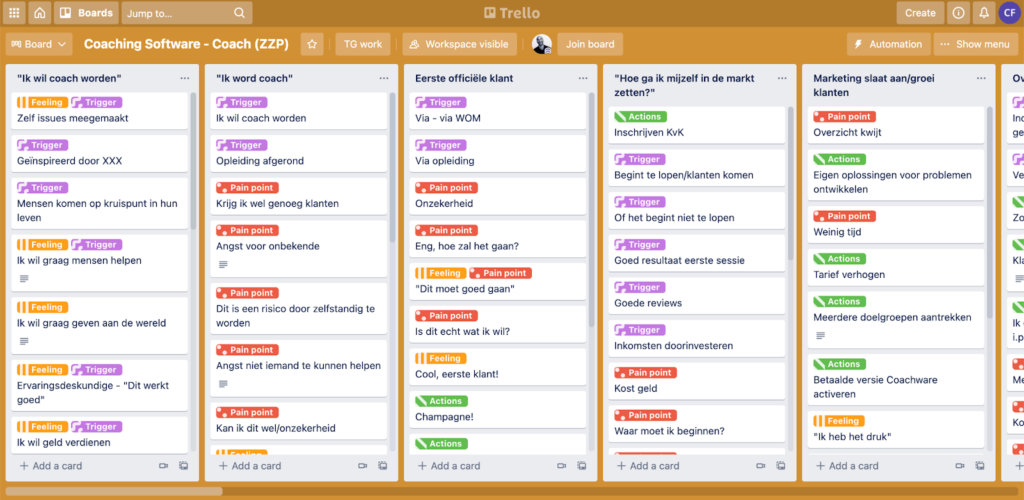
Step 3: Key Brainstorm
Now that you have worked out the phases of your coaching business, it is time for a brainstorm.
Step by step you will create 'cards' that belong to a certain 'list'.
Write down everything that comes to mind. Even though it seems ambiguous, there is a reason why you write it down again, but in a different way.
Examples of the cards for the first list “I want to become a coach”:
- I have experienced issues myself and want to protect others
- I am inspired by…
- I would like to help people
- I want to make money
So write down all the things that come to mind when you ask yourself the question: “why do I want to become a coach?”
A useful tool is to ask yourself the following questions:
- What feeling or feelings are associated with this phase?
- What could be a trigger that makes “I want to become a coach?”
- Which pain points are associated with the phase “I want to become a coach?”
- Which actions belong to the phase “I want to become a coach?”
- Which opportunities are part of the phase “I want to become a coach?”
- Are there any comments related to this phase?
“Give me six hours to chop down a tree and I will spend the first four sharpening the ax.”
Abraham Lincoln
If you notice during the process that your lists are no longer correct or logical, simply adjust them.
Step 4: Create labels
Once your brainstorming is complete, go to the next step. The step where you categorize everything from your brainstorm using 'labels.'
Use the following labels in Trello:
- Feeling
- This evokes a feeling: frustrated, happy, hopeful, uncertain,…
- Trigger
- This encourages you to take action: I want change, a coach can help me, the marketing of this coach appeals to me, I hear that coaching helps, I had a positive intake,...
- Pain point
- The negative thoughts that arise: can I afford this? Can I be helped? Paid intake? Where should I start looking for a coach? I won't succeed again.
- Action
- This encourages concrete action, for example: registering with the Chamber of Commerce.
- Opportunity
- This is the opportunity for you as a coach to take advantage of: make your prices transparent, explain why you can offer a solution to problem
- Remark
- This does not fall into any of the above labels, but it is still a figment of your imagination, idea or thought that you would like to write down.
Give your labels a color so that they stand out visually, see the example below.

Step 5: Create an overview
The last step is a very important one. Firstly, it offers you an overview by labeling everything. Secondly, you go through all the cards that came out of your brainstorm for a second time. This activates your brain again, allowing more connections to be made. This results in a deepening of your brainstorming. You will notice that this releases more ideas, giving you a more complete picture of all the possibilities and pitfalls.
So now that you have given the labels a color and a name, add the appropriate labels per card.
The advantage of the labels is that you can write down everything that comes to mind, even if you think it does not necessarily fit into the list. So it offers you more freedom in brainstorming. And the labels ensure that you can categorize all items.
By going through these steps you have processed both your conscious and subconscious thoughts and ideas in one overview. An additional advantage is that you have thought much more deeply about your coaching business than the average coach.
The more knowledge you have about yourself, where you want to go and how you are going to go about it, the greater your chance of a successful (in every possible way) coaching business.
Come on!
Do you have any questions/comments or suggestions? Write them down below or share them with us personally!
“I believe luck is preparation meeting opportunity. If you hadn't been prepared when the opportunity came along, you wouldn't have been lucky.”
Oprah Winfrey

